
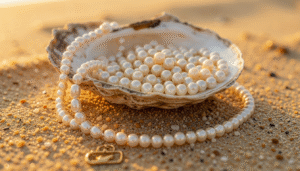
 Bahraini pearls are the most treasured gems in the Arabian Gulf because they carry within them a history that is inseparable from the identity of an entire nation. For thousands of years, before oil changed the world, pearls were the lifeblood of Bahrain’s economy, culture, and international reputation. A single Bahraini pearl represents the skill of generations of divers who risked their lives in the depths of the Gulf, the expertise of merchants who traded along ancient routes from the Gulf to India to Europe, and the natural wonder of a sea that produces some of the most exquisite gems on earth. Understanding this heritage transforms how you see and value every pearl you wear.
Sohan Jewellers celebrates this remarkable tradition by offering a curated selection of pearl jewelry that honors Bahraini heritage while meeting the demands of modern style. This article explores the full story of Bahraini pearls, from their geological origins to their place in contemporary fine jewelry.
The Ancient History of Pearl Diving in Bahrain
Pearl diving in Bahrain predates recorded history. Archaeological evidence from Dilmun, the ancient civilization that flourished in what is now Bahrain, shows that pearls were valued and traded as far back as 2000 BCE. Ancient texts from Mesopotamia reference the pearls of the Gulf as among the most prized goods in the ancient world. The Greeks called Bahrain “Tylos” and described it as a source of extraordinary pearls. Persian poets wrote of Gulf pearls with reverence. Indian merchants built entire trade networks around the Gulf pearl supply.
By the 19th century, Bahrain had become the undisputed center of the global pearl trade. The bahraini pearl season ran from May to September each year, when fleets of dhows, the traditional wooden sailing vessels of the Gulf, would set out to the pearl beds in the shallow waters surrounding the islands. Entire families depended on the annual pearl harvest. Towns were built, economies organized, and social hierarchies shaped by the pearl trade.
The pearl divers themselves were called “ghawwasin” (singular: “ghawwas”), which means “those who plunge.” Their work was extraordinarily dangerous. They dived without oxygen equipment, relying entirely on lung capacity, using a nose clip (called “fatam”) made of turtle shell or bone, and weighted belts to help them sink quickly to the seabed. A skilled diver could make dozens of dives per day and hold his breath for up to two minutes each time. The physical toll was immense, and many divers suffered hearing damage, eye problems, and other health consequences over the course of their careers.
The pearl trade began to collapse in the 1930s when Japanese entrepreneur Mikimoto Kokichi perfected the technique of culturing pearls, making it possible to produce pearls artificially at industrial scale. The global market for natural pearls was devastated almost overnight. For Bahrain, this economic catastrophe coincided with the discovery of oil, which provided an alternative economic foundation. But the memory and meaning of the pearl era never faded.
What Makes Bahraini Natural Pearls Unique
Not all pearls are equal, and Bahraini natural pearls occupy a category of their own. The specific conditions of the Arabian Gulf create pearls with characteristics that pearl experts and collectors regard as unmatched. The warm, shallow waters around Bahrain are rich in plankton and minerals that feed the Pinctada radiata oyster, the species responsible for Bahraini pearls. This diet, combined with the mineral composition of Gulf water, produces pearls with a distinctive luster, color, and surface quality.
The luster of a pearl refers to the quality of light reflection from its surface. A high-luster pearl appears to glow from within, as if it contains its own light source. Bahraini pearls are famous for this internal glow. The nacre (pronounced NAY-ker), the iridescent substance produced by the oyster to coat the irritant that becomes a pearl, is laid down in extremely thin layers over many years. The thickness and regularity of the nacre layers determine the quality of the luster. Bahraini natural pearls develop over many years in their host oysters, producing nacre of exceptional depth and quality.
The color range of Bahraini pearls is also distinctive. While many people picture pearls as white or cream, Bahraini natural pearls come in a beautiful spectrum from bright white to warm champagne, gold, pale rose, and silver. Each color is created by the specific mineral environment the oyster inhabits and the genetics of the individual oyster. The rarest and most valuable Bahraini pearls have a warm golden-pink overtone that is called “pink rose” in the pearl trade, and it is virtually impossible to reproduce in cultured pearls.
The surface of a genuine natural pearl will show slight irregularities under close inspection. These are not defects; they are proof of natural origin. A perfectly round, absolutely smooth pearl is almost certainly cultured. The slight variations in surface, shape, and color that characterize natural Bahraini pearls are what experts look for when authenticating their origin. Each natural pearl is genuinely unique, which is part of what makes it so precious.
Natural vs. Cultured Pearls: Understanding the Difference
A natural pearl forms when a foreign particle (a grain of sand, a parasite, or a piece of shell) enters an oyster accidentally. The oyster responds by coating the irritant with layers of nacre. This process is entirely spontaneous and the oyster has no control over the shape, size, or quality of the pearl it produces. Natural pearls are exceptionally rare; only one in every several thousand wild oysters produces a gem-quality pearl. This scarcity is the primary reason natural Bahraini pearls command premium prices.
A cultured pearl is created when a human technician intentionally inserts a nucleus (usually a round bead made from shell) into an oyster or mussel and places the animal back in the water to coat the nucleus with nacre. The process produces pearls more reliably and in larger quantities than natural formation. Japanese Akoya cultured pearls, Chinese freshwater cultured pearls, and Tahitian and South Sea cultured pearls are the major categories available globally.
The key difference is that a natural pearl is entirely nacre, while a cultured pearl has a bead nucleus at its center that is coated with a relatively thin layer of nacre. An X-ray can reveal the presence of a nucleus in a cultured pearl. This difference in nacre depth affects both the longevity of the pearl (natural pearls with thick nacre are more resistant to surface damage over time) and its luster (deeper nacre creates a richer, more complex glow).
Cultured pearls are genuinely beautiful and offer excellent value. They are not fake pearls; they are real pearls grown in real oysters. But they are different from natural pearls, and their prices reflect this difference. At Sohan Jewellers, both natural and cultured pearl jewelry options are clearly identified, so you can make a fully informed decision about what you are purchasing.
Pearl Jewelry Styles That Celebrate Bahraini Heritage
Incorporating pearls into jewelry that honors Bahraini heritage means combining the pearl with design elements that reference the Gulf’s cultural and artistic traditions. Classic Bahraini pearl necklaces feature a single strand of graduated natural pearls, with the largest pearl at the center and progressively smaller pearls toward the clasp. This design is elegant in its simplicity and has been a signature piece of Gulf jewelry for centuries. It is the style most associated with Bahraini pearl heritage in the minds of collectors and historians worldwide.
Pearl drop earrings set in yellow gold are another quintessential Bahraini jewelry form. The gold setting references the Gulf’s love of high-karat yellow gold, while the pearl itself provides the cool, lustrous counterpoint. Many traditional designs feature small diamond accents or filigree goldwork surrounding the pearl, creating a piece that is simultaneously a jewel and a cultural artifact.
Pearl rings have also been an important jewelry tradition in Bahrain. A large central pearl set in a gold bezel (a metal rim that encircles the pearl) is one of the oldest ring designs in the Gulf. Modern versions of this design are available in contemporary settings that pair the pearl with diamonds in pavé or halo configurations. These updated designs allow women to wear a piece with deep cultural roots in a completely modern way. Sohan Jewellers carries pearl rings for women that honor this tradition beautifully.
Pearl jewelry sets, combining a necklace, earrings, bracelet, and ring in a coordinating design, are deeply popular for brides in Bahrain. Wearing a full suite of pearl jewelry on your wedding day connects you to generations of Bahraini women who have done the same. It is a powerful act of cultural continuity as well as a stunning aesthetic choice. Sohan Jewellers offers bridal pearl jewelry sets in the jewelry sets for women collection, with options ranging from classic single-strand designs to contemporary mixed pearl and diamond collections.
How to Identify and Authenticate a Genuine Bahraini Pearl
If you are purchasing a piece described as containing a genuine natural Bahraini pearl, there are several ways to verify its authenticity. The most reliable method is to ask for a certificate from a recognized gemological laboratory. Organizations such as the Bahrain Institute for Pearls and Gemstones (DANAT) issue certificates for Bahraini natural pearls that confirm the pearl’s natural origin, place of origin (when determinable), and quality characteristics. A certificate from DANAT is considered the gold standard for pearl authentication in Bahrain.
A basic home test for natural vs. imitation pearls involves gently rubbing the pearl against your front tooth. A genuine pearl, whether natural or cultured, will feel slightly gritty because of the crystalline structure of the nacre. A glass or plastic imitation pearl will feel perfectly smooth. This test does not distinguish between natural and cultured pearls, but it does identify imitations.
Visual examination under a loupe (a small magnifying glass used by jewelers) can also reveal important information. Natural pearls often show a layered, slightly irregular surface structure under magnification. Cultured pearls may show a distinct line between the nucleus and the nacre layer when viewed at an edge. These distinctions require some training to interpret, which is why consulting a qualified gemologist is always the best approach for significant purchases.
Always buy pearl jewelry from a trusted retailer who provides clear documentation about what you are purchasing. Sohan Jewellers is committed to full transparency about the materials in every piece of jewelry it sells. For natural Bahraini pearl pieces, detailed provenance and quality information is provided so you can shop with complete confidence.
Caring for Your Pearl Jewelry
Pearls are organic gems, which means they require more careful handling than diamonds or other mineral stones. The nacre that gives pearls their beauty is composed of calcium carbonate, which is vulnerable to acids, chemicals, heat, and abrasion. Understanding basic pearl care ensures your pearl jewelry remains beautiful for generations.
The most important rule is: pearls come last. Apply perfume, hairspray, and cosmetics before putting on your pearl jewelry. These products contain chemicals and alcohol that can erode the nacre surface over time, dulling the luster and causing the pearl to lose its glow. Even sweat has mild acidic properties, so wiping your pearls gently with a soft, damp cloth after each wearing keeps them clean and fresh.
Store pearl jewelry separately from harder gems and metal pieces to prevent scratching. A soft cloth pouch or a lined jewelry box compartment is ideal. Pearl necklaces should be stored laid flat rather than hanging, because the thread that strings the pearls can stretch with the weight of the pearls over time, leading to a loose or uneven strand. Have your pearl necklace restrung by a professional jeweler every few years, or whenever the string shows signs of wear.
Never use ultrasonic cleaners, steam cleaners, or harsh chemical cleaners on pearls. These methods are excellent for diamonds and metal jewelry but will damage or destroy pearl nacre. A soft cloth dampened with plain water is all you need for routine cleaning. For deeper cleaning, a mild solution of diluted dish soap applied with a very soft cloth, followed by a rinse with clean water and immediate drying with a soft towel, is safe and effective. Bring your pearl jewelry to Sohan Jewellers for professional inspection and advice on maintaining any piece from the necklaces for women or other collections.
Bahraini pearls are more than beautiful objects. They are living testimonies to a culture of courage, skill, and natural wonder that shaped an entire civilization. Wearing a genuine Bahraini pearl connects you to a lineage of women who valued these gems not just for their beauty but for everything they represent: the depth of the sea, the patience of the oyster, and the courage of the men who brought them to light. At Sohan Jewellers, we are honored to keep this tradition alive through our pearl jewelry collection. Visit us and let the pearls of Bahrain become part of your story.