
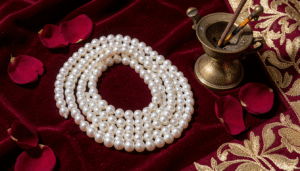
 Pearl necklaces in Gulf traditions carry a depth of meaning that goes far beyond their beauty as an accessory. Across the Arabian Gulf, and especially in Bahrain where pearl diving defined entire communities for thousands of years, pearl jewelry has been woven into the most sacred and significant moments of human life. Births, weddings, festivals, and farewells have all been marked by the giving and wearing of pearls in ways that reveal profound values of family, status, love, and spiritual connection.
To truly understand a pearl necklace in the Gulf context, you need to understand the world that produced it. The people who dove for these pearls, the families who waited on shore, the merchants who traded them, and the women who wore them all participated in a shared cultural story that made the pearl much more than a gemstone. This article explores that story and explains why pearl jewelry continues to hold such a special place in the hearts of Gulf women today.
Pearls as a Symbol of Status and Wealth in the Gulf
For centuries, owning a fine pearl necklace in the Gulf was one of the clearest possible signals of social status and prosperity. At a time before oil money and modern financial instruments, pearls represented real wealth. Wealthy merchant families displayed their success through the pearl jewelry they gave their wives and daughters, and the quality and quantity of pearls a woman wore told the community everything about her family’s standing.
The finest pearls, known as jiwan in Arabic, were perfectly round, had a deep orient (the internal glow caused by light passing through layers of nacre), and came in warm cream or rose-tinged white tones. A necklace made from matched jiwan pearls was extraordinarily valuable and typically owned only by the wealthiest families in Bahrain, Qatar, Kuwait, and the other Gulf pearl-producing regions. These pieces were displayed at formal gatherings and major celebrations as a quiet but unmistakable statement of power and prosperity.
Even families of more modest means would save to acquire a single good pearl or a small strand that could be worn on special occasions. The pearl represented aspiration as much as current status. A mother might save her pearls for her daughter’s wedding, giving the girl a tangible piece of the family’s history and a foundation for her new life. This practice reinforced the pearl’s status as not just jewelry but a form of stored value and family legacy.
This status symbolism has not disappeared entirely in modern Bahrain. The wearing of natural Gulf pearls, especially at formal events, still communicates something important about the wearer’s connection to Bahraini heritage and cultural pride. Today, Sohan Jewellers honors this tradition by offering beautifully crafted
The Role of Pearl Necklaces in Bahraini Weddings
No occasion in Gulf culture has been more closely associated with pearl jewelry than the wedding. In traditional Bahraini weddings, pearl necklaces played multiple roles that reflected the values of the marriage ceremony itself. The giving of pearls from a groom’s family to the bride was a standard part of the wedding gift tradition, known as the mahr or dowry, alongside gold, cash, and other valuables. The pearls given as part of the mahr belonged entirely to the bride and could not be reclaimed, making them a genuine act of wealth transfer and respect.
The pearl necklace given at a wedding was chosen with great care. It needed to reflect the groom’s family’s generosity and the value they placed on the union. A bride who received a fine pearl strand knew that her in-laws considered her worthy of their best. Conversely, a poor quality or small gift of pearls was sometimes read as a slight, and families negotiated pearl gifts with the same seriousness as any other aspect of the marriage agreement.
Beyond the mahr, pearl jewelry was also an important part of the bride’s own preparation. Bahraini brides traditionally wore multi-layered pearl necklaces as part of their wedding outfit, combining strands of different lengths to create a layered effect that was both dramatic and deeply traditional. Complementary
The pearl’s association with purity, emotional depth, and natural beauty made it a perfect symbol for marriage. Unlike diamonds or rubies, which are formed deep underground through volcanic pressure, pearls grow inside living creatures in response to an irritant. Some Gulf poets have likened this process to the way love grows from initial friction and difficulty into something luminous and precious. This metaphor resonated deeply in a culture where marriage was understood as a serious lifelong commitment requiring patience, faith, and effort.
Pearls in Islamic Cultural and Spiritual Context
Islam, the dominant faith across the Gulf, has its own relationship with pearls that adds a spiritual dimension to their cultural significance. The Quran mentions pearls directly in multiple verses describing the rewards of paradise. In Surah Al-Waqi’ah, the inhabitants of paradise are described as wearing fine garments and adorned with pearls. In Surah Al-Rahman, the blessed are compared to pearls and coral. These Quranic references gave pearls a sacred resonance that made them feel not just beautiful but blessed.
In Gulf Islamic culture, wearing pearls was considered appropriate and even encouraged for women because the Quran implicitly endorsed their beauty. Unlike some forms of ornamentation that religious scholars debated, pearls never carried controversy. Their natural origin, their Quranic mention, and their association with modesty and elegance made them the ideal choice for Muslim women who wanted to express beauty within the boundaries of their faith.
Pearl gifts given at religious celebrations like Eid Al-Fitr and Eid Al-Adha carry added meaning because of this sacred context. Gifting a pearl necklace at Eid communicates not just affection but a wish for blessing and divine favor for the recipient. The act of giving feels aligned with the spirit of generosity and gratitude that characterizes the Eid celebration, and the recipient knows that the gift was chosen thoughtfully in a spirit of faith and love.
Religious scholars and cultural historians in Bahrain have noted that the pearl’s status in Islamic consciousness helped preserve the pearl diving tradition even during difficult economic periods. Communities were motivated not just by profit but by a sense that their work had a kind of divine sanction. This spiritual dimension added psychological and social resilience to the industry and helps explain why pearl culture was so deeply embedded across all levels of Gulf society, not just among the wealthy.
Pearl Gifting Traditions Across the Gulf Calendar
Gulf culture has a rich tradition of marking important moments with gifts, and pearl necklaces appear throughout the calendar of life’s significant events. Beyond weddings and Eid, pearls were traditionally given at the birth of a child, particularly a girl, as an investment in her future and a recognition of her arrival into the family. A small pearl pendant given at birth would be kept safe until the child was old enough to wear it and understand its significance.
Coming-of-age celebrations also featured pearl gifts in traditional Bahraini culture. When a girl reached adolescence and was considered ready to begin preparing for her adult life and eventual marriage, she would often receive her first significant pearl necklace from her mother or grandmother. This moment marked a threshold in her life and connected her physically to the older women in her family who had worn similar pearls before her. The necklace was both an adornment and a rite of passage.
Milestone anniversaries, particularly the fortieth and fiftieth wedding anniversaries, were marked with pearl gifts in many Gulf families. The fortieth anniversary is sometimes called the pearl anniversary in cultures worldwide, and the Gulf tradition of pearl gifting at this milestone predates the Western custom by many centuries. A husband who wished to honor four decades of marriage might commission a new pearl necklace to complement his wife’s existing collection, acknowledging both the passage of time and the enduring value of their union.
Recovery from illness was another occasion when pearl jewelry was sometimes gifted in Gulf culture. The pearl’s reputation for bringing health, emotional balance, and protection made it a meaningful gift for someone returning to wellness. This custom reflects the broader Gulf belief in the pearl as a living gem with properties beyond the purely aesthetic, an object that carries energy and intention from the giver to the receiver. Exploring the full range of
How Modern Gulf Women Honor This Tradition
Contemporary Bahraini and Gulf women navigate the pearl tradition thoughtfully, balancing deep cultural respect with modern sensibilities and lifestyles. Many women cherish the pearl necklaces they inherited from their mothers and grandmothers as irreplaceable family heirlooms, but they are also open to wearing modern pearl designs that incorporate the gem into fresh, contemporary contexts. This dual approach honors the past while living fully in the present.
The styling of pearl jewelry has evolved significantly over the past two decades. Where previous generations wore formal multi-strand necklaces reserved for ceremonial occasions, many modern Gulf women integrate pearl jewelry into their everyday wardrobes. A single pearl pendant on a delicate gold chain is just as likely to be worn with a casual abaya or smart office outfit as with a formal gown. This casualization of pearl jewelry has made the tradition more accessible and kept it relevant for younger women who might otherwise feel disconnected from it.
Social media has played an interesting role in the revival of pearl jewelry appreciation among younger Gulf women. Content creators and influencers from Bahrain, Kuwait, and the UAE who share their appreciation for traditional Gulf jewelry have introduced a new generation to the beauty and meaning of pearl necklaces. Seeing these pieces styled in contemporary ways makes the tradition feel living and evolving rather than museum-bound, and it has sparked renewed interest in learning the stories behind the jewelry.
Sohan Jewellers responds to this modern moment by offering pearl jewelry that bridges tradition and contemporary style. The store’s collection of
The Emotional Language of Pearl Necklaces in Gulf Culture
Beyond status, spirituality, and occasion, the pearl necklace in Gulf culture speaks an emotional language that is understood across generations. Pearls are associated with tears in several Gulf poetic traditions, not because they represent sadness, but because they represent the emotion of depth, the things that matter most and move us most profoundly. When a Gulf woman gives or receives a pearl necklace, there is an unspoken acknowledgment that this gift carries genuine feeling.
The patience required to form a pearl resonates emotionally in Gulf culture, where patience and endurance are considered high virtues. A pearl takes years to grow to its full size and beauty. The nacre builds up in microscopic layers, each one adding to the whole over time. In a culture that values the long view, the sustained effort, and the delayed reward, the pearl’s growth process mirrors the values people aspire to embody. Wearing a pearl is, in some sense, an affirmation of these values.
Mother-daughter relationships have a particularly strong association with pearl jewelry in Gulf culture. The act of a mother placing a pearl necklace around her daughter’s neck is loaded with meaning: protection, love, blessing, the passing of feminine wisdom, and the acknowledgment of a continuing lineage. These moments are often photographed and remembered as some of the most emotionally significant in a family’s life. The necklace becomes a physical record of that love, something the daughter can touch and feel years after her mother is gone.
This emotional depth is why pearl jewelry continues to matter in the Gulf despite enormous changes in wealth, lifestyle, and fashion. The pearl necklace is not just beautiful. It is a container for memory, love, and cultural identity. As long as there are Bahraini mothers who place pearls around their daughters’ necks, and daughters who understand what that gesture means, the pearl necklace will remain one of the most powerful objects in Gulf culture.
The meaning behind pearl necklaces in Gulf traditions is layered, profound, and deeply human. These gems have carried messages of love, status, faith, hope, and identity across thousands of years and hundreds of generations. Understanding this meaning transforms the way you see and appreciate pearl jewelry, whether you are from the Gulf or discovering this tradition for the first time.
Sohan Jewellers is proud to be part of this living tradition, offering a collection of pearl necklaces and complementary jewelry that honors the heritage of Gulf pearl culture while making it accessible to every woman who values beauty with meaning.