
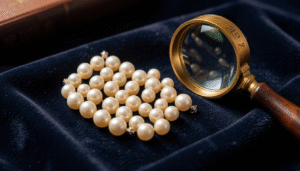
 Pearl grading explained simply is this: it is the process experts use to assess and communicate the quality of a pearl using a consistent set of criteria. For anyone buying or investing in Bahraini pearls, understanding grading gives you the knowledge to make confident, informed decisions and avoid overpaying for lesser-quality gems.
Bahraini natural pearls are among the world’s most precious gems, and evaluating them correctly requires more than a quick glance. Grading involves examining several key factors: luster, surface quality, shape, size, color, and nacre thickness. Each factor tells you something important about the pearl’s quality and its likely long-term value.
Luster: The Most Important Quality Factor
Luster is the quality of light that reflects from and through the surface of a pearl. It is the first thing expert graders look at, and it is the single most important indicator of a pearl’s quality. High luster is what gives a fine Bahraini pearl its famous glow, that feeling that the light is coming from inside the pearl rather than just bouncing off its surface.
To evaluate luster, hold the pearl under a single light source, ideally a small, focused light like a penlight. Look at the reflection in the surface of the pearl. A pearl with excellent luster shows a sharp, bright, mirror-like reflection. You should almost be able to see your own face in a top-quality pearl. A pearl with poor luster shows a hazy, diffuse reflection with soft edges.
The GIA, which stands for the Gemological Institute of America, grades luster on a five-point scale: excellent, very good, good, fair, and poor. At reputable jewelers and auction houses, pearl descriptions include a luster grade so buyers can compare pieces objectively. When a Bahraini pearl has excellent or very good luster, it commands a significant price premium over pearls with lower luster grades.
Luster is determined primarily by nacre quality. Thick, well-organized nacre layers diffract and reflect light in the complex way that produces deep luster. Thin or poorly organized nacre produces dull, chalky luster. This is why Bahraini natural pearls, with their exceptionally thick nacre, consistently outperform cultured pearls in luster evaluations.
Surface Quality: Reading the Pearl’s Skin
Surface quality refers to the presence or absence of blemishes, irregularities, and imperfections on the pearl’s exterior. These include pits, bumps, spots, cracks, and areas where the nacre surface is disrupted in some way.
Surface quality is graded on a scale from clean (no visible blemishes under 10x magnification) to heavily blemished (significant blemishes visible to the naked eye that affect the pearl’s beauty and durability). Most natural pearls fall somewhere in between these extremes.
An important insight for natural pearl buyers: minor surface blemishes on a natural Bahraini pearl are not necessarily a negative indicator. In fact, a complete absence of any surface character can sometimes indicate a cultured or imitation pearl, which forms under controlled conditions. Natural pearls form in the wild, and minor blemishes confirm their genuine origin. Expert graders understand this distinction and do not penalize natural pearls for minor surface characteristics that are typical of the natural formation process.
Blemishes that do affect value significantly are those that penetrate deeply into the nacre, crack the surface in ways that could worsen over time, or sit in a highly visible position on the pearl’s face. When buying pearl jewelry for women, ask your jeweler to point out any significant surface characteristics so you can evaluate them in context.
Shape: Beyond Round
While perfectly round pearls are the most famous and generally the most valuable, the world of pearl shapes is far richer than a single category. Understanding pearl shapes helps you evaluate a wider range of pieces and find excellent value in shapes that less-informed buyers overlook.
Graders classify pearl shapes into three main categories. Round and near-round pearls are the most symmetrical. Symmetrical shapes include ovals, buttons (flattened spheres), and drops (pear shapes), all of which are symmetrical when rotated on their central axis. Baroque shapes are pearls with irregular, non-symmetrical forms, ranging from gently asymmetrical to dramatically organic in shape.
Round natural Bahraini pearls are extraordinarily rare. Producing a round natural pearl requires the mollusk to coat the irritant evenly in all directions over many years. The slightest variation in the pearl’s position, the water conditions, or the mollusk’s health can alter the shape. When you encounter a genuinely round natural Bahraini pearl, the price reflects that rarity.
Baroque Bahraini pearls deserve more recognition than they typically receive. Large, lustrous baroque pearls with strong orient can be spectacular gems that represent outstanding value compared to round pearls of equivalent luster and size. Many sophisticated collectors actively prefer baroque shapes for their individuality and organic beauty.
Size: Why Millimeters Matter
Pearl size is measured in millimeters as the diameter at the pearl’s widest point. Size matters enormously in pearl valuation, but the relationship is not linear. A pearl that is twice as large as another is worth far more than twice as much, because larger pearls are disproportionately rarer.
In the Bahraini natural pearl market, size ranges from approximately two to three millimeters for the smallest seed pearls up to ten millimeters or more for the largest fine specimens. Pearls above seven millimeters are considered large and command strong premiums. Pearls above nine millimeters are exceptional and are priced accordingly.
When comparing sizes in a matched pearl necklace or set, the grader measures the size consistency across all the pearls as well as their individual size. A matched necklace where every pearl falls within 0.5 millimeters of the same size is far more valuable than an unmatched assortment. The labor involved in collecting enough matching natural pearls for a full necklace can take decades.
Color: Reading the Overtones
Pearl color has two components: body color and overtone. Body color is the primary, dominant color of the pearl’s surface. In Bahraini pearls, body color typically ranges from white and cream to light gold and occasionally pink. Overtone is the secondary color that appears to float above the body color as a translucent tint, the result of light interacting with the nacre’s surface layers.
Bahraini pearls are known for their distinctive rose or cream overtones. A white Bahraini pearl with a rose overtone is considered especially desirable and commands a premium over a plain white pearl without overtone. The combination of a warm body color with a complementary overtone creates the complex, dimensional color that makes Bahraini pearls so unique.
Orient is a special optical effect beyond standard overtone, where multiple iridescent colors appear to move across the pearl’s surface as it is rotated in the light. Not all Bahraini pearls display strong orient, but those that do are considered top-tier gems. Orient is caused by light diffracting through multiple thin nacre layers and recombining in a rainbow effect. It is a direct indicator of exceptional nacre quality
Nacre Thickness: The Foundation of Everything
Nacre thickness is the foundation on which all other quality factors rest. Thick nacre produces better luster, more durable surfaces, and deeper orient. In natural Bahraini pearls, nacre thickness is always maximal because the entire pearl is composed of nacre from center to surface, unlike cultured pearls that have a bead nucleus inside.
In cultured pearls, nacre thickness can be measured with X-ray equipment, and graders look for a minimum nacre coating thickness on the bead nucleus. In natural pearls, nacre thickness is confirmed by gemological testing that distinguishes natural pearls from cultured ones. The Bahrain Institute for Pearls and Gemstones, Danat, provides official certification that includes confirmation of natural status and nacre composition.
When evaluating any pearl described as Bahraini, insist on Danat certification or equivalent gemological documentation. The certification confirms the pearl’s natural origin, provides grading information, and gives you confidence in the authenticity of your purchase. Uncertified pearls sold as natural Bahraini pearls carry significant risk of misrepresentation.
Bahraini pearl jewelry sets at Sohan Jewellers are sourced with attention to quality and authenticity, so you can shop with confidence.
Pearl grading gives you a powerful framework for evaluating Bahraini pearls objectively. Armed with knowledge of luster, surface quality, shape, size, color, and nacre thickness, you can approach every pearl purchase with the confidence of a professional. Sohan Jewellers invites you to explore a curated selection of Bahraini pearl jewelry where quality and authenticity are never compromised.