
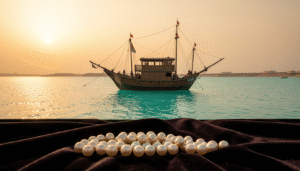
 Bahrain pearl capital of the world is a title this tiny island nation earned over thousands of years of maritime tradition and natural abundance. Long before oil was discovered beneath the desert, Bahrain was already a jewel of the ancient world, celebrated for the finest natural pearls ever pulled from the sea. Today, that legacy lives on in the jewelry shops, the museums, and the hearts of Bahraini people who wear pearls as a symbol of pride and identity.
Understanding why Bahrain holds this title requires a journey through history, geography, and culture. From the ancient trade routes of the Dilmun civilization to the bustling souqs of Manama, pearls have shaped Bahrain in ways that go far deeper than commerce.
The Geography That Made Bahrain Perfect for Pearling
Bahrain sits at the heart of the Arabian Gulf, surrounded by warm, shallow waters that happen to be ideal for pearl oyster growth. The surrounding sea, especially in areas known as the Hawar Islands and the northern banks, maintains the precise balance of salinity, temperature, and nutrients that oysters need to produce high-quality nacre. Nacre is the shimmering material inside an oyster that builds up in layers to form a pearl.
The sea floor around Bahrain is covered in a particular type of rocky seabed that oysters love to cling to. This, combined with freshwater springs that bubble up from the seafloor and mix with the saltwater, creates conditions found almost nowhere else on earth. These springs slightly dilute the salinity in specific patches of the Gulf, which research suggests encourages oysters to produce thicker, rounder, and more luminescent pearls.
The Bahraini pearling banks, known locally as Harat, spread across hundreds of square kilometers. Divers would row out in traditional wooden boats called dhows, dive to depths of up to fifteen meters with nothing but a nose clip, a weighted rope, and a mesh bag, and collect dozens of oysters in a single breath. This practice was not just a job. It was a way of life passed down through generations, and the geography of Bahrain made it uniquely possible.
The waters also stayed warm enough for most of the year to support diving seasons that lasted from late spring through early autumn. Other regions of the world had pearl oysters, too, but none combined the water quality, the oyster density, and the natural conditions of Bahrain quite so perfectly. Historians and marine biologists who have studied the region agree that Bahrain produced some of the most naturally beautiful pearls ever found.
The Ancient Roots of Pearl Trading in Bahrain
The story of Bahrain and pearls stretches back more than four thousand years. Bahrain was the heart of the ancient Dilmun civilization, which acted as a major trading hub between Mesopotamia and the Indus Valley. Merchants from what is now Iraq and India would converge on Bahrain to exchange goods, and pearls were among the most valuable commodities moving through this network.
Ancient Sumerian texts mention Dilmun as a source of precious goods, and archaeologists have found evidence of pearl trade in burial sites across the island dating back to the second millennium BCE. The pearl was not simply a luxury item. It held spiritual significance, was used as currency, and was considered a gift fit for royalty and gods.
As centuries passed and empires rose and fell around the Gulf, Bahrain remained a constant center of pearl commerce. The Babylonians, Persians, Greeks, and later the Romans all prized Bahraini pearls. Roman writers described them as the finest in the world, noting their rare luster and perfectly round shape. This reputation attracted merchants from across the known world and cemented Bahrain’s status as the go-to source for natural pearls.
By the medieval period, Arab geographers and traders were writing extensively about Bahrain’s pearl industry. The island became a regular stop on the maritime Silk Road that connected East Africa, Arabia, India, and China. Pearls from Bahrain ended up in the courts of Mughal emperors, European kings, and Chinese dynasties. The trade was so significant that it shaped the entire economic and social structure of the island.
The Golden Age of Bahraini Pearl Diving
The eighteenth and nineteenth centuries are widely considered the golden age of Bahrain’s pearl industry. During this period, the industry dominated the entire economy of the Gulf region. Historians estimate that at its peak, Bahrain had over thirty thousand pearl divers working in fleets of more than five thousand boats. Nearly every family on the island had some connection to the pearling industry, whether as divers, boat captains, merchants, or rope pullers.
The diving season was a major cultural event. Each year, families would gather on the shore to bid farewell to the men heading out to the pearling banks. The divers would spend weeks at sea, surviving on simple food and water, diving repeatedly from sunrise to sunset. The work was exhausting and dangerous. Sharks, jellyfish, pressure injuries from deep dives, and the constant physical strain took a serious toll. Yet divers continued year after year because the pearls they brought back supported their families and communities.
The social hierarchy of the pearling fleet was elaborate and well-defined. The nakhoda, or boat captain, organized the expedition and negotiated with merchants. The divers, known as ghawwas, performed the actual underwater work. The seyb were the rope pullers who lowered and raised the divers. Each person had a specific role, and the entire system was governed by a set of customs and agreements that had evolved over centuries.
The pearls collected during each season would be sorted, graded, and sold to merchants in Bahrain’s famous pearl markets. Buyers from India, Europe, and the Americas would travel to Manama specifically to purchase Bahraini pearls at auction. The prices commanded by the best specimens were extraordinary, and fortunes were made and lost in the pearl trade every year.
How Bahrain’s Pearl Heritage Shaped Its Culture
The pearl industry did not just shape Bahrain’s economy. It shaped the entire culture, identity, and social fabric of the island. The pearl is woven into Bahraini poetry, music, architecture, and everyday language. Songs about the sea and the divers are still sung at festivals and weddings. The architecture of old Bahraini homes reflects the wealth generated by pearl money, with ornate wind towers and carved wooden doors that display the prosperity of families who profited from the trade.
The pearl also influenced Bahraini fashion in deep and lasting ways. Generations of Bahraini women adorned themselves with pearl jewelry as a mark of social status, family heritage, and beauty. Mothers passed pearl necklaces down to daughters, and these pieces became cherished heirlooms rather than mere accessories. The tradition of gifting pearl jewelry at weddings, births, and major milestones became embedded in Bahraini culture and continues today.
UNESCO recognized the significance of this heritage in 2012 by inscribing the Pearling Trail in Bahrain on the World Heritage List. The trail includes seventeen buildings in Muharraq city, three offshore oyster beds, and a fort that together tell the story of Bahrain’s pearling civilization. This is the only remaining pearl city in the world that still preserves a complete architectural and cultural heritage from the pearling era.
Bahrain also hosts the annual Pearl Festival, which celebrates this heritage through cultural performances, traditional crafts, and exhibitions of historical pearl jewelry. The festival attracts visitors from across the Gulf and the wider Arab world who come to connect with a tradition that once defined the entire region. The celebration keeps the memory alive and ensures that younger generations understand where Bahrain’s identity comes from.
The Decline of Natural Pearling and Bahrain’s Response
The natural pearling industry faced a catastrophic blow in the early twentieth century when Japanese inventor Mikimoto Kokichi developed a reliable process for culturing pearls in 1916. Cultured pearls, which are grown by inserting a small bead into an oyster to stimulate nacre production, could be produced in large quantities and sold at much lower prices than natural pearls. The global market for natural pearls collapsed almost overnight.
For Bahrain, the timing was devastating. The island’s entire economy had been built on pearls for centuries. When demand for natural pearls evaporated, the social and economic fabric of the country came under enormous strain. Fortunately for Bahrain, oil was discovered in 1932, which provided a new economic foundation. However, the loss of the pearl industry left a cultural void that the Bahraini people have never entirely filled.
Bahrain’s response to this loss has been one of preservation and celebration rather than abandonment. The government and cultural institutions have worked hard to document the history of pearling, restore historical buildings associated with the trade, and promote Bahrain’s pearl heritage as a key part of its national identity. The Bahrain National Museum houses an extensive collection of historical pearl jewelry, diving equipment, and documents that tell the full story of the industry.
Today, a small number of natural pearl merchants still operate in Bahrain, sourcing the rare natural pearls that still occasionally come from Gulf waters. These gems are extraordinarily valuable, sometimes selling for many times the price of their cultured equivalents. Sohan Jewellers celebrates this heritage by offering beautiful
Bahrain’s Pearl Industry in the Modern World
Even in the modern era, Bahrain maintains its position as a global center of pearl knowledge and trade. The country is home to expert pearl graders, gemologists, and historians who specialize in evaluating natural Gulf pearls. These experts are consulted by collectors and auction houses around the world when authenticity and provenance need to be established for rare pieces.
The Bahrain Institute for Pearls and Gemstones, known as DANAT, is a world-class facility that tests and certifies pearls from across the Gulf. DANAT uses advanced scientific equipment to distinguish natural pearls from cultured ones and to verify that pearls described as Gulf-origin genuinely come from the Arabian Gulf. This certification is internationally recognized and adds significant value to pearls that carry the DANAT seal of approval.
Modern Bahraini jewelry designers draw heavily on the pearl heritage in their work. They combine traditional pearl motifs with contemporary styling to create pieces that feel both rooted in history and relevant to modern tastes. This design philosophy reflects the broader cultural approach in Bahrain, which values tradition without being trapped by it. The result is a jewelry scene that is uniquely Bahraini and globally appealing.
For anyone who loves jewelry, visiting Bahrain offers an experience that goes far beyond shopping. Walking through the old pearl market in Manama, touching the worn wooden counters where merchants once traded fortunes in pearls, and seeing the actual diving equipment used by generations of brave divers gives a profound appreciation for the pearl as more than a pretty gem. It is a symbol of human courage, craftsmanship, and connection to the natural world. Sohan Jewellers is proud to carry beautiful
Bahrain’s title as the pearl capital of the world was not given lightly. It was earned over millennia through the labor of thousands of divers, the genius of merchants, and the natural fortune of geography. The pearls that came from these waters changed the course of history, shaped an entire civilization, and created a cultural legacy that Bahrain still carries with great pride. When you wear a pearl today, you are connecting with one of humanity’s oldest and most beautiful traditions.
Whether you are drawn to pearls for their natural beauty, their cultural significance, or simply their timeless elegance, Sohan Jewellers offers a curated collection that honors this remarkable heritage. Each piece is chosen to reflect the quality and craftsmanship that Bahrain has always been known for, making every purchase a small piece of this extraordinary story.
Bahrain pearl capital of the world is a title this tiny island nation earned over thousands of years of maritime tradition and natural abundance. Long before oil was discovered beneath the desert, Bahrain was already a jewel of the ancient world, celebrated for the finest natural pearls ever pulled from the sea. Today, that legacy lives on in the jewelry shops, the museums, and the hearts of Bahraini people who wear pearls as a symbol of pride and identity.
Understanding why Bahrain holds this title requires a journey through history, geography, and culture. From the ancient trade routes of the Dilmun civilization to the bustling souqs of Manama, pearls have shaped Bahrain in ways that go far deeper than commerce.
The Geography That Made Bahrain Perfect for Pearling
Bahrain sits at the heart of the Arabian Gulf, surrounded by warm, shallow waters that happen to be ideal for pearl oyster growth. The surrounding sea, especially in areas known as the Hawar Islands and the northern banks, maintains the precise balance of salinity, temperature, and nutrients that oysters need to produce high-quality nacre. Nacre is the shimmering material inside an oyster that builds up in layers to form a pearl.
The sea floor around Bahrain is covered in a particular type of rocky seabed that oysters love to cling to. This, combined with freshwater springs that bubble up from the seafloor and mix with the saltwater, creates conditions found almost nowhere else on earth. These springs slightly dilute the salinity in specific patches of the Gulf, which research suggests encourages oysters to produce thicker, rounder, and more luminescent pearls.
The Bahraini pearling banks, known locally as Harat, spread across hundreds of square kilometers. Divers would row out in traditional wooden boats called dhows, dive to depths of up to fifteen meters with nothing but a nose clip, a weighted rope, and a mesh bag, and collect dozens of oysters in a single breath. This practice was not just a job. It was a way of life passed down through generations, and the geography of Bahrain made it uniquely possible.
The waters also stayed warm enough for most of the year to support diving seasons that lasted from late spring through early autumn. Other regions of the world had pearl oysters, too, but none combined the water quality, the oyster density, and the natural conditions of Bahrain quite so perfectly. Historians and marine biologists who have studied the region agree that Bahrain produced some of the most naturally beautiful pearls ever found.
The Ancient Roots of Pearl Trading in Bahrain
The story of Bahrain and pearls stretches back more than four thousand years. Bahrain was the heart of the ancient Dilmun civilization, which acted as a major trading hub between Mesopotamia and the Indus Valley. Merchants from what is now Iraq and India would converge on Bahrain to exchange goods, and pearls were among the most valuable commodities moving through this network.
Ancient Sumerian texts mention Dilmun as a source of precious goods, and archaeologists have found evidence of pearl trade in burial sites across the island dating back to the second millennium BCE. The pearl was not simply a luxury item. It held spiritual significance, was used as currency, and was considered a gift fit for royalty and gods.
As centuries passed and empires rose and fell around the Gulf, Bahrain remained a constant center of pearl commerce. The Babylonians, Persians, Greeks, and later the Romans all prized Bahraini pearls. Roman writers described them as the finest in the world, noting their rare luster and perfectly round shape. This reputation attracted merchants from across the known world and cemented Bahrain’s status as the go-to source for natural pearls.
By the medieval period, Arab geographers and traders were writing extensively about Bahrain’s pearl industry. The island became a regular stop on the maritime Silk Road that connected East Africa, Arabia, India, and China. Pearls from Bahrain ended up in the courts of Mughal emperors, European kings, and Chinese dynasties. The trade was so significant that it shaped the entire economic and social structure of the island.
The Golden Age of Bahraini Pearl Diving
The eighteenth and nineteenth centuries are widely considered the golden age of Bahrain’s pearl industry. During this period, the industry dominated the entire economy of the Gulf region. Historians estimate that at its peak, Bahrain had over thirty thousand pearl divers working in fleets of more than five thousand boats. Nearly every family on the island had some connection to the pearling industry, whether as divers, boat captains, merchants, or rope pullers.
The diving season was a major cultural event. Each year, families would gather on the shore to bid farewell to the men heading out to the pearling banks. The divers would spend weeks at sea, surviving on simple food and water, diving repeatedly from sunrise to sunset. The work was exhausting and dangerous. Sharks, jellyfish, pressure injuries from deep dives, and the constant physical strain took a serious toll. Yet divers continued year after year because the pearls they brought back supported their families and communities.
The social hierarchy of the pearling fleet was elaborate and well-defined. The nakhoda, or boat captain, organized the expedition and negotiated with merchants. The divers, known as ghawwas, performed the actual underwater work. The seyb were the rope pullers who lowered and raised the divers. Each person had a specific role, and the entire system was governed by a set of customs and agreements that had evolved over centuries.
The pearls collected during each season would be sorted, graded, and sold to merchants in Bahrain’s famous pearl markets. Buyers from India, Europe, and the Americas would travel to Manama specifically to purchase Bahraini pearls at auction. The prices commanded by the best specimens were extraordinary, and fortunes were made and lost in the pearl trade every year.
How Bahrain’s Pearl Heritage Shaped Its Culture
The pearl industry did not just shape Bahrain’s economy. It shaped the entire culture, identity, and social fabric of the island. The pearl is woven into Bahraini poetry, music, architecture, and everyday language. Songs about the sea and the divers are still sung at festivals and weddings. The architecture of old Bahraini homes reflects the wealth generated by pearl money, with ornate wind towers and carved wooden doors that display the prosperity of families who profited from the trade.
The pearl also influenced Bahraini fashion in deep and lasting ways. Generations of Bahraini women adorned themselves with pearl jewelry as a mark of social status, family heritage, and beauty. Mothers passed pearl necklaces down to daughters, and these pieces became cherished heirlooms rather than mere accessories. The tradition of gifting pearl jewelry at weddings, births, and major milestones became embedded in Bahraini culture and continues today.
UNESCO recognized the significance of this heritage in 2012 by inscribing the Pearling Trail in Bahrain on the World Heritage List. The trail includes seventeen buildings in Muharraq city, three offshore oyster beds, and a fort that together tell the story of Bahrain’s pearling civilization. This is the only remaining pearl city in the world that still preserves a complete architectural and cultural heritage from the pearling era.
Bahrain also hosts the annual Pearl Festival, which celebrates this heritage through cultural performances, traditional crafts, and exhibitions of historical pearl jewelry. The festival attracts visitors from across the Gulf and the wider Arab world who come to connect with a tradition that once defined the entire region. The celebration keeps the memory alive and ensures that younger generations understand where Bahrain’s identity comes from.
The Decline of Natural Pearling and Bahrain’s Response
The natural pearling industry faced a catastrophic blow in the early twentieth century when Japanese inventor Mikimoto Kokichi developed a reliable process for culturing pearls in 1916. Cultured pearls, which are grown by inserting a small bead into an oyster to stimulate nacre production, could be produced in large quantities and sold at much lower prices than natural pearls. The global market for natural pearls collapsed almost overnight.
For Bahrain, the timing was devastating. The island’s entire economy had been built on pearls for centuries. When demand for natural pearls evaporated, the social and economic fabric of the country came under enormous strain. Fortunately for Bahrain, oil was discovered in 1932, which provided a new economic foundation. However, the loss of the pearl industry left a cultural void that the Bahraini people have never entirely filled.
Bahrain’s response to this loss has been one of preservation and celebration rather than abandonment. The government and cultural institutions have worked hard to document the history of pearling, restore historical buildings associated with the trade, and promote Bahrain’s pearl heritage as a key part of its national identity. The Bahrain National Museum houses an extensive collection of historical pearl jewelry, diving equipment, and documents that tell the full story of the industry.
Today, a small number of natural pearl merchants still operate in Bahrain, sourcing the rare natural pearls that still occasionally come from Gulf waters. These gems are extraordinarily valuable, sometimes selling for many times the price of their cultured equivalents. Sohan Jewellers celebrates this heritage by offering beautiful
Bahrain’s Pearl Industry in the Modern World
Even in the modern era, Bahrain maintains its position as a global center of pearl knowledge and trade. The country is home to expert pearl graders, gemologists, and historians who specialize in evaluating natural Gulf pearls. These experts are consulted by collectors and auction houses around the world when authenticity and provenance need to be established for rare pieces.
The Bahrain Institute for Pearls and Gemstones, known as DANAT, is a world-class facility that tests and certifies pearls from across the Gulf. DANAT uses advanced scientific equipment to distinguish natural pearls from cultured ones and to verify that pearls described as Gulf-origin genuinely come from the Arabian Gulf. This certification is internationally recognized and adds significant value to pearls that carry the DANAT seal of approval.
Modern Bahraini jewelry designers draw heavily on the pearl heritage in their work. They combine traditional pearl motifs with contemporary styling to create pieces that feel both rooted in history and relevant to modern tastes. This design philosophy reflects the broader cultural approach in Bahrain, which values tradition without being trapped by it. The result is a jewelry scene that is uniquely Bahraini and globally appealing.
For anyone who loves jewelry, visiting Bahrain offers an experience that goes far beyond shopping. Walking through the old pearl market in Manama, touching the worn wooden counters where merchants once traded fortunes in pearls, and seeing the actual diving equipment used by generations of brave divers gives a profound appreciation for the pearl as more than a pretty gem. It is a symbol of human courage, craftsmanship, and connection to the natural world. Sohan Jewellers is proud to carry beautiful
Bahrain’s title as the pearl capital of the world was not given lightly. It was earned over millennia through the labor of thousands of divers, the genius of merchants, and the natural fortune of geography. The pearls that came from these waters changed the course of history, shaped an entire civilization, and created a cultural legacy that Bahrain still carries with great pride. When you wear a pearl today, you are connecting with one of humanity’s oldest and most beautiful traditions.
Whether you are drawn to pearls for their natural beauty, their cultural significance, or simply their timeless elegance, Sohan Jewellers offers a curated collection that honors this remarkable heritage. Each piece is chosen to reflect the quality and craftsmanship that Bahrain has always been known for, making every purchase a small piece of this extraordinary story.