
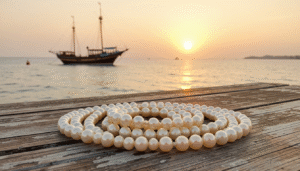
 Bahrain pearl diving is one of the most remarkable traditions in the Arab world, a practice that sustained entire communities for centuries and shaped the identity of a nation. Long before oil transformed the Gulf economy, the natural pearl was Bahrain’s greatest treasure, pulled from the seabed by skilled divers who risked their lives for the precious gems that buyers around the world coveted.
Today, the pearl diving tradition lives on in a transformed way. The industry may no longer dominate the economy, but the pearl remains deeply embedded in Bahraini culture, identity, and of course, jewelry. Understanding this history gives a deeper appreciation for every pearl piece you wear.
The Golden Age of Bahraini Pearl Diving
From at least the first century CE through the early twentieth century, Bahrain was known worldwide as the source of the finest natural pearls. Arab, Persian, Indian, and European merchants all competed to buy Bahraini pearls, which were prized for their exceptional luster and round shape. At the height of the industry, thousands of boats and tens of thousands of men participated in the annual diving season.
The diving season typically ran from May through September, when the warm Gulf waters were calmer and more suitable for sustained diving operations. Boat crews would sail to the pearl banks, areas of the sea floor known to contain oyster beds, and anchor there for weeks at a time. Divers would descend repeatedly throughout the day, holding their breath for up to two minutes per dive, collecting oysters in mesh bags and surfacing to hand them to waiting crew members.
The work was extraordinarily demanding. Divers faced risks from sharks, jellyfish, and other marine creatures. The physical strain of repeated breath-hold diving caused long-term health problems for many. The financial arrangements were also often exploitative, with divers frequently indebted to boat captains and merchants through a system that was difficult to escape.
Despite these hardships, pearl diving created a distinctive culture. The songs sung on the boats, called fidjeri, are among the most haunting and beautiful forms of traditional Gulf music. The craft skills of boat building, net making, and oyster processing all flourished around the pearl industry. The social bonds formed among diving crews were legendary for their depth and loyalty.
The Bahraini Pearl: Nature’s Perfect Jewel
What made Bahraini pearls so special? The answer lies in the unique conditions of the Arabian Gulf. The waters around Bahrain are relatively shallow, warm, and rich in the microscopic organisms that feed pearl oysters. Fresh water springs on the sea floor, a geological peculiarity (natural springs that rise up from the seabed), create a mixing of fresh and salt water that seems to produce oysters with an exceptional capacity for creating lustrous pearls.
Natural pearls form when an irritant, such as a grain of sand or a parasite, enters an oyster. The oyster responds by coating the irritant with layer after layer of nacre (a shimmering substance made of calcium carbonate, which is the same material that forms the oyster’s shell). Over years, these layers build up to create a pearl. The quality of the nacre determines the pearl’s luster: how much light it reflects and how deeply it seems to glow from within.
Bahraini pearls were consistently rated among the finest in the world for their thick nacre layers and exceptional luster. They commanded premium prices in markets from London to Mumbai to Beijing. A single exceptional pearl could be worth a fortune, and a matched set of pearls for a necklace could be worth more than most people would earn in a lifetime.
The rarity of truly fine natural pearls makes them more valuable than ever today. Unlike cultured pearls (pearls grown with human assistance by inserting an irritant into the oyster), natural pearls form entirely without human intervention. Finding a natural pearl of high quality in the modern age is genuinely rare, which is why natural Bahraini pearls remain among the most precious gemstones in existence.
The Decline and the Cultural Survival
The Bahraini pearl industry collapsed with startling speed in the early twentieth century. Two developments combined to destroy it: the invention of cultured pearls by Japanese entrepreneur Mikimoto Kokichi in the 1890s, and the discovery of oil in Bahrain in 1932. Cultured pearls flooded the global market with affordable pearl jewelry, destroying the price premium that natural Bahraini pearls had commanded. Oil offered Bahraini workers vastly better pay and far safer working conditions.
Within a generation, the diving fleets were gone. The elaborate social and economic structures built around pearl diving dissolved. Many of the songs, stories, and craft traditions that had been passed down through generations of diving families were lost.
But the pearl did not disappear from Bahraini consciousness. It remained deeply embedded in national identity, art, and jewelry traditions. The Bahrain government has made significant efforts to preserve and celebrate the pearl diving heritage. The Pearling Path, a UNESCO World Heritage Site, traces the route from the old merchant houses through the town to the sea, preserving physical evidence of the industry’s importance.
Today, younger generations of Bahrainis are showing renewed interest in their pearl heritage. Cultural festivals, museum exhibitions, and heritage programs all celebrate the pearl diving tradition. And of course, pearl jewelry remains one of the most beloved categories of adornment for Bahraini women.
Pearl Jewelry Today: Honoring Tradition in Modern Style
The enduring love of pearl jewelry in Bahrain is both a cultural statement and an aesthetic choice. Pearls have a timeless quality that suits both traditional and contemporary styles. Their soft, luminous glow flatters virtually every skin tone, and their organic shape adds warmth to any outfit.
At Sohan Jewellers, pearl necklaces for women are designed with deep respect for the tradition they represent. Whether you choose a classic strand of cultured pearls, a modern pendant featuring a single pearl, or an elaborate multi-strand design, you are participating in a jewelry tradition that goes back centuries.
Pearl earrings are another beloved choice. Simple pearl studs are among the most versatile jewelry pieces a woman can own, appropriate for everything from casual daily wear to formal occasions. More elaborate pearl drop earrings and chandelier designs featuring pearl accents are perfect for celebrations and special events.
Contemporary designers are also finding new ways to incorporate pearl motifs without using the pearls themselves. Pearl-shaped gold pendants, earrings with pearl-like curves, and jewelry sets that play with the round, organic forms of the natural pearl all pay tribute to Bahrain’s heritage in fresh, modern ways.
Visiting Bahrain’s Pearl Heritage Sites
For those who want to connect more deeply with Bahrain’s pearl history, the island offers several remarkable heritage sites. The Pearling Path, which runs through Muharraq, is the best starting point. Walking this UNESCO-recognized route, you pass old merchant houses, boat building workshops, and the beach from which divers once set out for the pearl banks.
The Bahrain National Museum in Manama houses an exceptional collection of pearl diving artifacts, including the tools divers used, traditional clothing, and historical photographs that capture the industry at its height. The museum also displays some of the finest natural Bahraini pearls ever found, giving visitors a sense of the extraordinary treasures that once lay beneath the Gulf’s surface.
The Bait Al Quran cultural center, which focuses on Islamic arts and heritage, often features exhibitions on traditional Bahraini crafts including jewelry making. These exhibitions provide context for understanding how pearl jewelry fit into the broader cultural and religious life of the community.
Spending time at these sites before purchasing pearl jewelry adds depth to the experience. When you understand the history and effort behind each pearl, your jewelry becomes more than decoration. It becomes a small piece of an extraordinary human story.
Choosing Pearl Jewelry That Lasts
Pearl jewelry requires some specific care to maintain its beauty over time. Pearls are relatively soft on the Mohs hardness scale, rating between 2.5 and 4.5, which means they can be scratched by contact with harder materials. They are also sensitive to acids, including perfumes, hairsprays, and even the natural acids in perspiration.
The golden rule for pearl care is to put them on last, after applying perfume, hairspray, and makeup. These products can dull the nacre’s surface and reduce the pearl’s luster over time. When you remove your pearl jewelry, wipe each piece gently with a soft, clean cloth before storing it.
Store pearl jewelry separately from other pieces, wrapped in soft fabric or in individual pouches. Contact with harder gemstones can cause surface scratches that are difficult or impossible to repair. Pearl necklaces should be restrung every few years, as the silk thread on which they are typically strung can weaken and break over time.
With proper care, quality pearl jewelry lasts for decades and even generations. The pearl jewelry collection at Sohan Jewellers is designed for longevity, using quality settings and clasps that protect the pearls and ensure they remain securely in place through years of regular wear.
Bahrain pearl diving is a tradition that shaped a nation, built a culture, and left a legacy that lives on in every pearl necklace, bracelet, and earring worn by Bahraini women today. The pearl is not just a beautiful object. It is a symbol of everything Bahrain has been and continues to be: a place where beauty is drawn up from the depths through skill, courage, and enduring human tradition.
Explore the pearl jewelry collection at Sohan Jewellers and find a piece that connects you to this remarkable story.