
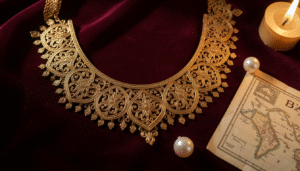
 The history of gold necklaces in Bahraini jewelry culture stretches back more than four thousand years, making gold one of the most enduring symbols of beauty and status in this region. Long before Bahrain became the nation we know today, its people wore gold as a mark of prosperity, protection, and pride. Understanding that history helps us appreciate why gold necklaces remain so central to Bahraini women’s jewelry today.
Gold has always held deep cultural and spiritual meaning across the Arabian Gulf. Families pass gold down through generations, and gold jewelry given at weddings and celebrations carries emotional weight that goes far beyond its market value. At Sohan Jewellers, we honor this tradition by offering gold necklace styles that connect modern women to a heritage that is rich, proud, and alive.
Gold in Ancient Bahrain: The Dilmun Civilization
Bahrain was the heart of the ancient Dilmun civilization, one of the earliest known cultures in the Arabian Gulf region. Archaeological excavations across Bahrain have uncovered gold ornaments, including rings, bracelets, and necklace fragments, buried with the dead as offerings for the afterlife. These findings date back to roughly 2000 BCE and show that gold jewelry held deep spiritual and cultural significance from the very beginning of Bahrain’s recorded history.
The Dilmun people were skilled traders who connected Mesopotamia (modern-day Iraq) with the Indus Valley (modern-day Pakistan and India). Gold flowed through Bahrain along these ancient trade routes. Dilmun became known as a land of abundance and purity in Sumerian texts, and gold was central to that image. The jewelry found at Dilmun burial sites shows a level of craftsmanship that rivals pieces made centuries later in more famous ancient civilizations.
Necklace-like ornaments found at these sites often featured beads of gold combined with carnelian, a red semi-precious stone, and lapis lazuli, a deep blue stone imported from Central Asia. This combination of gold with colorful stones set a pattern for Bahraini jewelry design that continued for centuries. Color, texture, and craftsmanship were valued from the very start.
These early pieces were not merely decorative. They served as amulets believed to protect the wearer from harm and evil spirits. Gold was considered a divine metal, connected to the sun and to the gods. Wearing gold was an act of devotion as much as an act of adornment. That spiritual dimension of gold jewelry persists in Bahraini culture even today, where gold gifts at births and weddings carry blessings and good wishes.
The Dilmun legacy reminds us that Bahrain’s relationship with gold is ancient and profound. Every gold necklace made and worn in Bahrain today stands on the shoulders of thousands of years of craft, trade, and meaning.
The Islamic Golden Age and Bahraini Goldsmithing
When Islam spread across the Arabian Peninsula in the 7th century CE, it brought with it a new set of values and aesthetic principles that shaped jewelry design in Bahrain for centuries. Islamic art celebrated geometry, calligraphy, and intricate patterns. Gold jewelry from this period features detailed geometric engravings, arabesque designs (interlaced floral and vine patterns), and inscriptions from the Quran rendered in flowing Arabic calligraphy.
Bahraini goldsmiths became especially skilled at a technique called filigree, which involves twisting and weaving thin gold wire into delicate lace-like patterns. Filigree gold necklaces from this era are masterpieces of patience and precision. Each piece could take weeks or even months to complete, and the results were stunning. A filigree gold necklace was a sign of extraordinary wealth and taste because only the finest craftsmen could produce them.
The Islamic Golden Age also saw the rise of the souk (traditional marketplace) as the center of commerce and culture. The gold souks of Bahrain became famous trading destinations where merchants from Persia, India, and Africa came to buy and sell jewelry. These interactions brought new techniques, designs, and gemstones into Bahraini jewelry culture. Indian ruby settings, Persian turquoise, and East African coral found their way into Bahraini gold necklaces during this period, creating a wonderfully diverse jewelry tradition.
Women wore gold necklaces as a form of portable savings in an era without modern banks. A woman’s gold jewelry represented her financial security and her family’s prosperity. This practical dimension added another layer of importance to gold necklaces beyond their decorative and spiritual roles. A bride’s gold jewelry, given by her family and her groom’s family at marriage, was hers to keep and pass on.
This tradition shaped how Bahraini families think about gold jewelry even now. Gold is not just an accessory. It is an investment, a safety net, and a legacy. When a woman wears a gold necklace, she wears something loaded with meaning that extends far beyond fashion.
The Pearl Trade Era and Its Influence on Gold Jewelry
From roughly the 18th century until the 1930s, Bahrain’s economy was dominated by the natural pearl trade. The divers who harvested pearls from the Gulf were mostly men, but the pearl trade created enormous wealth that flowed through every part of Bahraini society. That wealth found a natural outlet in gold jewelry.
Pearl merchants and trading families commissioned elaborate gold necklaces to demonstrate their success. Gold necklaces set with natural Bahraini pearls became the most prestigious form of jewelry a woman could own. The combination of gold and pearl was a direct expression of Bahrain’s two greatest natural treasures working in harmony. These pieces were worn at weddings, celebrations, and important social gatherings as statements of family prestige and cultural pride.
The designs of this era often featured heavy gold chains with large pendant settings holding multiple pearls or clusters of pearls surrounded by diamond chips. The scale of the jewelry was grand and deliberate. Bigger, heavier necklaces communicated more wealth and status. The craftsmanship was meticulous, with goldsmiths spending considerable time on each individual link in a chain or each tiny setting holding a pearl.
The collapse of the natural pearl market in the early 1930s, caused by the introduction of cultured pearls from Japan, was a devastating blow to Bahrain’s economy. Many pearl merchants lost their fortunes almost overnight. Some families sold their gold jewelry to survive. The memory of that loss deepened the cultural value placed on gold jewelry as a stable asset that could always be relied upon in difficult times.
That historical memory is why Bahraini women still place enormous importance on their gold jewelry collections. Gold is seen as something that holds its value when everything else falls away. This is not superstition but lived experience passed down through family stories and cultural memory.
20th Century Modernization and New Jewelry Styles
The discovery of oil in Bahrain in 1932 transformed the country’s economy and society. New wealth flowed in, and Bahrain began to modernize rapidly. The jewelry trade evolved alongside these changes. New gold necklace styles arrived from Europe, the United States, and East Asia, blending with traditional Bahraini designs to create a diverse and exciting jewelry market.
Italian gold chains became especially popular in Bahrain during the mid-20th century. The intricate link patterns of Italian chain making, styles like figaro, curb, and rope chains, offered Bahraini women a new vocabulary for gold jewelry. These chains were lighter and more versatile than the heavy traditional pieces of earlier eras, and they suited the busier, more mobile lifestyles of modern Bahraini women.
At the same time, traditional Bahraini craftsmanship did not disappear. Skilled artisans continued making handcrafted gold necklaces using techniques passed down through generations. The market developed a healthy split between contemporary imported designs and traditional handcrafted pieces, giving women a wide range of choices to suit different occasions and preferences.
The gold souks of Manama, Bahrain’s capital, remained the center of the jewelry trade throughout this period. Walking through the gold souk today, you can still see this diversity on display. Modern Italian chains sit beside traditional Gulf-style pieces. Contemporary diamond-set gold necklaces share cases with classic filigree designs. It is a living museum of the history described in this article.
Sohan Jewellers reflects this same spirit of diversity and quality. Our necklaces for women collection brings together classic gold designs and modern styles, giving today’s Bahraini woman access to the best of both traditions.
Traditional Wedding Gold: The Mahr Tradition
One of the most important cultural practices connecting gold necklaces to Bahraini life is the mahr tradition. In Islamic marriage law, the mahr is a mandatory gift from the groom to the bride, and in Bahrain and across the Gulf, gold jewelry is the most common form this gift takes. A gold necklace is almost always part of the wedding mahr, and the quality and quantity of gold given reflects the groom’s respect for his bride and his family’s generosity.
The mahr gold is considered the bride’s personal property from the moment it is given. No one, including her husband, can take it from her. This legal protection gives the mahr a deeply practical significance. It ensures that a bride enters her married life with assets of her own, providing her with a foundation of financial independence.
Choosing mahr jewelry is a serious and joyful process for Bahraini families. The bride often has significant input into the styles chosen, ensuring that the gold necklaces she receives are pieces she will love wearing for years. Families visit reputable jewelry shops and spend time selecting pieces that balance beauty, quality, and cultural appropriateness. The process strengthens family bonds and builds shared memories before the wedding day even arrives.
Wedding gold in Bahrain often includes matching sets of necklaces, bracelets, earrings, and rings. These coordinated sets are called parures, and they allow a bride to wear a fully harmonized jewelry look for her wedding day. Sohan Jewellers offers beautiful jewelry sets for women that are ideal for this important occasion, combining quality craftsmanship with designs that honor Bahraini traditions.
The mahr tradition ensures that gold necklaces remain central to Bahraini cultural life in a very direct and personal way. Every wedding reinforces the cultural value of gold and ensures that knowledge of fine jewelry passes from one generation to the next.
Gold Necklaces in Contemporary Bahraini Fashion
Today, Bahraini women wear gold necklaces in a wide variety of ways that blend tradition with contemporary fashion. Younger women might layer multiple delicate gold chains for a modern, editorial look. Older women might wear a single statement piece with traditional design elements for a classic, authoritative appearance. Both approaches draw from the same cultural well of deep appreciation for gold as a material and as a symbol.
Contemporary Bahraini jewelry designers are creating exciting new work that fuses traditional Gulf motifs with modern aesthetics. Geometric patterns inspired by Islamic architecture appear in new gold necklace designs. Traditional dhow boats, palm trees, and Arabic calligraphy inspire pendant shapes that feel both rooted in heritage and fresh in their execution.
International fashion trends also influence what Bahraini women wear. The global popularity of layered necklaces, charm pendants, and personalized name necklaces has found a ready audience in Bahrain. Women combine these trends with their cultural love of gold to create personal jewelry styles that are uniquely their own.
Social media has accelerated these trends, giving Bahraini women access to global jewelry fashion while also creating platforms where local designers and jewelers can share their work with international audiences. Bahrain’s jewelry culture is no longer confined to the local souk; it participates in global conversations about beauty, fashion, and heritage.
Sohan Jewellers is proud to be part of this living, evolving tradition. We offer contemporary gold necklace styles that speak to modern Bahraini women while never losing sight of the deep cultural roots that make gold jewelry so meaningful in this country. Our collection is a bridge between the past and the present, crafted for women who appreciate both.
The history of gold necklaces in Bahraini jewelry culture is a story of resilience, beauty, and meaning. From the ancient Dilmun civilization to the pearl trade era to the vibrant modern market of today, gold has always been at the center of how Bahraini women express their identity, celebrate their milestones, and connect with their heritage. At Sohan Jewellers, we are honored to carry that tradition forward, one beautiful gold necklace at a time.
Explore our gold necklace collection today and find a piece that becomes part of your own story.