
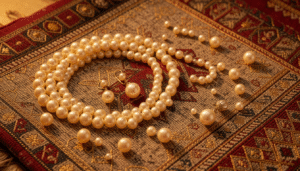
 The cultural significance of pearls in Bahraini heritage runs deeper than beauty or adornment. For centuries, the pearl was the soul of Bahrain’s economy, the pride of its people, and the foundation of its identity as a seafaring nation. Long before oil transformed the region, Bahrain was known throughout the ancient world as the Kingdom of Pearls, a place where men risked their lives beneath the sea to harvest the ocean’s most precious gift.
Today, that legacy lives on in the jewelry worn by Bahraini women, in the national consciousness, and in the cultural institutions that preserve the memory of the pearl diving era. Understanding pearls in their Bahraini context means understanding an entire civilization shaped by the sea.
The Ancient Origins of Pearl Diving in Bahrain
Archaeological evidence suggests that pearl fishing in the waters around Bahrain dates back more than four thousand years. Ancient texts from Mesopotamia and Dilmun, the historical name for the Bahrain archipelago, mention the prized gems of the Gulf as trade goods of extraordinary value. The Sumerian traders who passed through Dilmun carried Bahraini pearls to the courts and markets of the ancient world.
The natural conditions around Bahrain created an ideal environment for pearl-bearing oysters. The meeting of warm shallow seas with freshwater springs on the seabed produced water conditions that nourished oysters capable of producing exceptionally large and lustrous pearls. Bahraini pearls were famous across the ancient world for their distinctive warm ivory and golden hues, qualities still celebrated by pearl connoisseurs today.
Pearl diving was not an industry of the wealthy. It was the labor of ordinary Bahraini men, the divers known as ghawwas, and their boat captains known as nakhudas. Each summer, fleets of wooden dhow boats would leave the harbors of Bahrain and sail to the pearl beds of the Gulf. The divers would descend repeatedly, filling baskets with oysters, enduring the physical demands of deep freediving in warm salt water.
The pearl season, known as the ghaus, shaped the entire rhythm of Bahraini life. Families waited onshore for the return of their men. Women wore their finest gold and pearl jewelry during the celebrations that marked the beginning and end of the pearl season. These celebrations were among the most significant cultural events in the Bahraini calendar.
The economic and social structure of Bahraini society was built around pearl diving. The nakhuda held great social prestige. Merchants who traded pearls to buyers in India, Europe, and the Ottoman Empire accumulated wealth that funded the construction of Bahrain’s most beautiful historical buildings and the creation of its most magnificent jewelry traditions.
This ancient heritage is inseparable from the identity of Bahrain as a nation and as a culture. The pearl is not simply a gem in Bahrain. It is a living memory of ancestors, sacrifice, and the enduring beauty born from the sea.
Pearls and the Social Fabric of Bahraini Life
In traditional Bahraini society, pearls were far more than a commodity. They were woven into the social, spiritual, and ceremonial life of the community in ways that touched every aspect of daily existence.
Pearl jewelry formed a central part of a Bahraini woman’s dowry. A bride’s family measured wealth and status in part by the quality and quantity of pearl jewelry she brought into her marriage. Intricate pearl necklaces, earrings, and headpieces were passed from mother to daughter across generations, carrying with them family history and emotional significance that transcended their monetary value.
Pearl-set gold jewelry was the preferred gift for major life milestones. The birth of a child, especially a son, was celebrated with the gift of pearl jewelry to the mother. Eid celebrations, wedding anniversaries, and other occasions of joy were marked by the exchange of pearl-adorned pieces. Pearls carried a cultural message of love, prosperity, and blessing that no other gem could replicate in the Bahraini context.
The color and quality of pearls also carried social meaning. The most valuable pearls, perfectly round with a deep luster and warm overtone, were reserved for royalty and the wealthiest merchant families. Smaller, baroque, or slightly imperfect pearls were more widely available and formed the basis of everyday pearl jewelry worn by ordinary Bahraini women.
Religious and spiritual dimensions also connected to the pearl in Bahraini culture. The pristine white of a natural pearl evoked purity, and pearl jewelry was often part of ceremonial dress for religious celebrations. The Quran itself speaks of pearls as adornments of paradise, giving the gem a sacred resonance that deepened its cultural importance in an Islamic society.
The relationships within pearl diving communities were bound by complex social contracts. Divers often worked under a system of debt to their nakhudas, receiving advances against future pearl sales that kept many in a cycle of obligation. This economic reality added layers of complexity to the pearl’s cultural meaning. The gem was both a source of pride and, for many families, a reminder of hardship and sacrifice.
The Decline of Natural Pearl Diving and Its Cultural Legacy
The pearl diving era in Bahrain came to a dramatic and painful end in the 1930s. The introduction of cultured Japanese pearls to the global market flooded supply and collapsed prices for natural pearls almost overnight. The Great Depression further devastated the pearl trade, as luxury markets worldwide contracted sharply. The subsequent discovery of oil in Bahrain in 1932 redirected the economy entirely, and the pearl diving fleets gradually disappeared from Bahraini harbors.
The cultural trauma of this transition was profound. Entire communities built around the pearl trade lost their livelihoods and their social purpose within a single generation. Men who had spent their lives diving found no market for their skills. The knowledge of pearl diving, its songs, its rituals, and its technical expertise, began to fade as younger generations turned toward new industries.
Bahrain responded to this loss with a powerful commitment to cultural preservation. The Bahrain National Museum dedicates significant space to the pearl diving era, displaying antique diving equipment, pearl jewelry, and historical photographs. UNESCO recognized the traditions of pearl diving by inscribing them on the Representative List of Intangible Cultural Heritage of Humanity in 2012, a landmark acknowledgment of the pearl’s place in global cultural history.
The Bahrain Pearling Trail, a UNESCO World Heritage Site, preserves historic buildings, waterfront sites, and pearl beds associated with the industry. Walking this trail connects visitors to the living memory of Bahrain’s pearl era and deepens appreciation for the cultural legacy that pearls represent.
Annual pearl diving festivals and educational programs in Bahraini schools ensure that younger generations learn about the heritage of the ghaus and the significance of natural pearls to their national identity. The pearl is prominently featured in Bahraini visual art, poetry, music, and architecture, keeping its memory alive in the creative culture of the nation.
The loss of the pearl industry was painful, but the cultural legacy it created has proven enduring and irreplaceable. Bahrain’s pearl heritage is now a source of national pride and a cornerstone of its cultural tourism identity.
Bahraini Pearl Jewelry: Artistry and Tradition
The jewelry crafted from Bahraini pearls represents one of the highest expressions of the goldsmith’s art in the Gulf region. Traditional Bahraini pearl jewelry combined natural pearls with intricate yellow gold settings, often featuring filigree work, engraving, and granulation techniques that had been refined over centuries.
Bahraini pearl earrings were historically among the most elaborate in the region. Grand chandelier designs featured multiple tiers of pearl drops suspended from gold frames decorated with fine granulation. These earrings, known as khurs, were central to formal and ceremonial dress and remain highly sought-after antique pieces today.
Pearl necklaces in the Bahraini tradition ranged from simple single strands to complex multi-strand arrangements with graduated pearl sizes and elaborate gold clasps. The ability to assemble a perfectly matched strand of natural Bahraini pearls, all identical in color, luster, and size, was the mark of a master pearl dealer and a source of immense pride for its owner.
Headpieces incorporating pearls were an important element of bridal jewelry in historical Bahrain. These elaborate constructions of gold and pearl framed the face and caught the light beautifully. While the grandest historical headpieces are now primarily found in museums and private collections, their influence can be seen in the elaborate bridal jewelry collections still produced by jewelers like Sohan Jewellers today.
Contemporary Bahraini jewelry design honors this artisanal heritage while embracing modern aesthetics. Pearl jewelry sets for women today often blend natural or cultured pearls with clean geometric gold settings that reflect both tradition and contemporary taste. These modern interpretations allow a new generation of Bahraini women to wear their cultural heritage with a fresh and personal style.
The craftsmanship involved in creating fine pearl jewelry demands patience, skill, and a deep knowledge of the material. Each pearl must be assessed for its luster, orient (surface iridescence), shape, and surface quality before being matched with others or set in gold. This meticulous process ensures that every finished piece does justice to the natural beauty of the pearl and to the legacy of those who harvested it.
The Pearl in Contemporary Bahraini Identity and Fashion
In modern Bahrain, the pearl occupies a unique position as both a historical symbol and a living fashion statement. Bahraini women who wear pearl jewelry today are making a conscious connection to their heritage while participating in a global conversation about timeless elegance and refined style.
Pearl jewelry has experienced a remarkable global revival in recent years, embraced by younger generations who appreciate its organic beauty and cultural depth. In Bahrain, this revival has a special resonance because the pearl is not simply a fashion trend but a deeply personal cultural touchstone. When a young Bahraini woman wears pearl earrings for women, she participates in a tradition that stretches back thousands of years.
Bahraini designers and jewelers have worked hard to make pearl jewelry relevant for contemporary tastes. Pearls appear today in minimalist single-drop earrings as well as in bold sculptural rings and asymmetric pendants. The versatility of the pearl, its ability to suit both the most formal occasions and casual everyday looks, makes it an enduring choice for modern Bahraini women.
Pearl jewelry also plays an important role in Bahraini cultural diplomacy. State gifts from Bahrain to foreign dignitaries often include pearl jewelry, presenting the gem as a symbol of Bahraini generosity, history, and national pride. This diplomatic role further cements the pearl’s status as Bahrain’s most significant cultural emblem.
The annual Bahrain International Airshow and other major national events see Bahraini women wearing their finest pearl jewelry as a statement of national identity and personal elegance. Fashion weeks and luxury events in Manama increasingly celebrate the pearl as a defining feature of Bahraini style.
For anyone seeking to connect with the living spirit of Bahraini culture through jewelry, the pearl remains the most authentic and meaningful starting point. Its beauty is inseparable from its story, and that story is the story of Bahrain itself.
Caring for Your Pearl Jewelry to Honor Its Legacy
Pearl jewelry deserves care and respect that honors both its fragile natural beauty and its deep cultural significance. Unlike harder gemstones, pearls are organic gems composed primarily of calcium carbonate, making them sensitive to chemicals, acids, and physical abrasion. Understanding how to care for your pearls ensures they remain beautiful for generations.
Always put on your pearl jewelry after applying perfume, hairspray, or cosmetics. These substances contain chemicals and alcohol that can dull the pearl’s luster over time. The general rule is pearls last, meaning you dress and groom first, then put on your pearl jewelry as the final step before leaving the house.
After wearing pearl jewelry, gently wipe each piece with a soft, slightly damp cloth to remove any perspiration or residue. Allow the pieces to air dry completely before storing them. This simple habit dramatically extends the life and beauty of your pearls.
Store pearl jewelry separately from other jewelry to prevent scratching. A soft pouch or a lined jewelry box compartment protects pearl surfaces from contact with harder metals and gemstones. Never store pearls in airtight containers, as they benefit from a small amount of humidity to prevent drying and cracking of the nacre, the outer layer that creates their luster.
Have your pearl jewelry professionally cleaned and inspected periodically by a trusted jeweler. For strung pearl necklaces and bracelets, regular restringing on silk thread with knots between each pearl prevents loss and ensures the integrity of the piece. A reputable jeweler like Sohan Jewellers can provide expert care advice tailored to your specific pieces.
Treating your pearl jewelry with this level of care is more than a practical habit. It is an act of respect for the men who dived for these gems, the artisans who crafted them into beautiful objects, and the cultural heritage they represent. Well-cared-for pearl jewelry can be passed down through families for generations, carrying forward the story of Bahrain’s pearl legacy into the future.
The pearl is Bahrain’s most profound cultural symbol, a gem that carries within its luminous surface the memory of centuries of labor, artistry, trade, and identity. From the ancient dhow fleets of the ghaus to the contemporary jewelry collections of today, the pearl connects every generation of Bahraini people to a shared heritage of beauty and resilience.
At Sohan Jewellers, we celebrate this legacy by curating pearl jewelry that honors the traditions of Bahraini craftsmanship while embracing the elegance of modern design. Wearing a pearl is wearing a piece of Bahraini history, and there is no more beautiful way to carry that story forward.